If you have ever walked into a classic six on the Upper East Side or Upper West Side and thought, "This layout has great bones, but I need it to live differently," you are not alone. Many buyers love the scale, ceiling height, and separation these prewar apartments offer, yet still want a more modern flow, a second bath, or a real work-from-home setup. The good news is that some of the smartest updates are also the most practical, especially when you understand co-op rules, NYC permit requirements, and what the market is likely to reward. Let’s dive in.
Why classic six layouts still work
A classic six is a prewar apartment with six rooms: a living room, formal dining room, kitchen, two full bedrooms, and a maid’s room. Bathrooms are counted separately, and that smaller maid’s room often becomes the most flexible part of the layout.
On the Upper East Side and Upper West Side, these homes are especially associated with older co-op buildings. They tend to offer separate hallways, foyers, thick walls, and clearly defined rooms, which is exactly why they remain so appealing to buyers who want both character and reconfiguration potential.
Why buyers reconfigure classic sixes
The appeal is simple: you get prewar proportions with options. Instead of starting from scratch, you can often adapt the layout to fit how you actually live now.
In practice, three requests come up again and again on the UES and UWS:
- Opening the kitchen
- Adding a bath
- Creating a home office or guest room
Each one can improve daily life, but each comes with a different level of complexity, cost, and board scrutiny.
Opening the kitchen
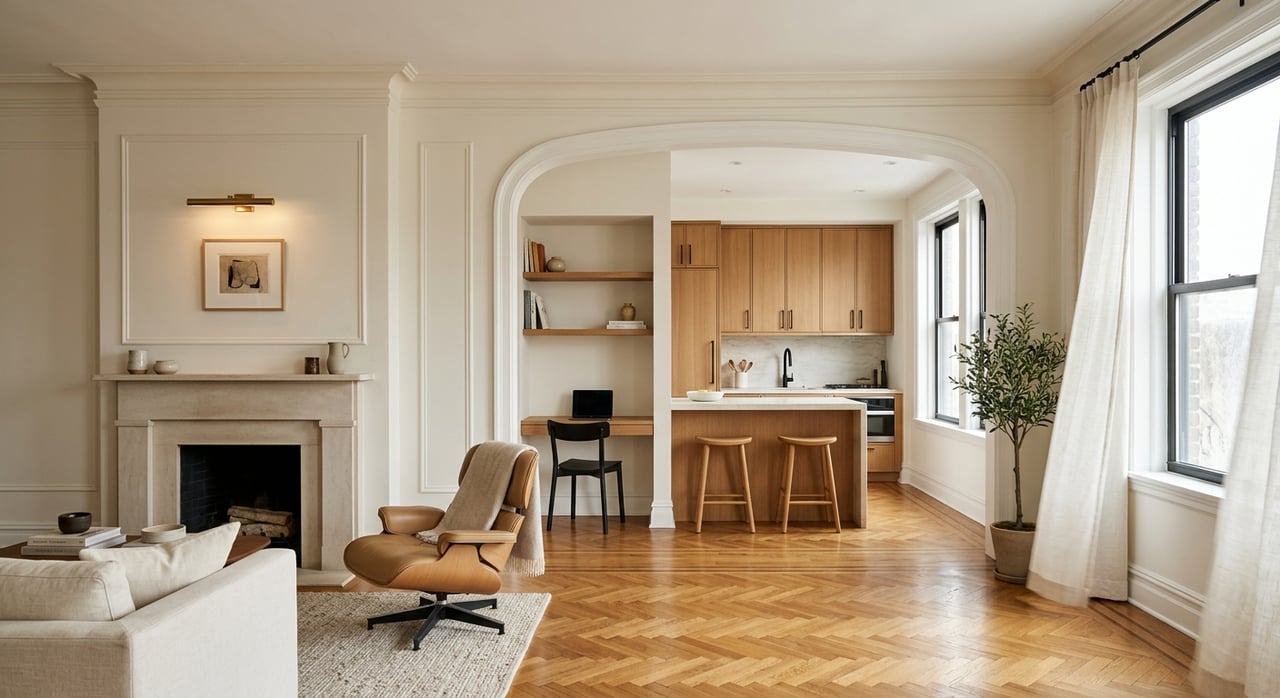
For many buyers, the first question is whether the kitchen can be opened to the dining room or living room. This is often the most popular update because it can make the apartment feel more connected while still preserving some of the formal structure that gives a classic six its identity.
In New York City, the answer depends on scope. The Department of Buildings says replacing cabinets alone does not require a permit, but rerouting gas piping, adding electrical outlets, or moving a load-bearing wall usually does, and kitchen renovations of that scale often require an ALT2 filed by a professional engineer or registered architect.
That matters because an open kitchen is rarely just a cosmetic change. Even when the design intent looks simple, the actual work may involve building systems, structural review, and a building approval process that can shape what is realistically possible.
When an open kitchen makes sense
An opened kitchen tends to work best when you want better flow without trying to erase the apartment’s prewar logic. In many classic sixes, the strongest result is not fully open plan living, but a more tailored reconfiguration that connects the kitchen and dining area while keeping a sense of definition.
From a value perspective, restraint often matters. The data in New York suggests that a minor kitchen remodel has a much stronger return than a major midrange or upscale gut renovation, which supports the case for thoughtful improvements over overly expensive overhauls.
Adding a second bath
A second bath is often the most meaningful functional upgrade in a classic six. It can make the apartment much easier to live in, especially if the maid’s room is being used as a guest room, office, or flexible sleeping area.
It is also the upgrade most likely to run into hard limits. The Department of Buildings says adding a new bathroom typically requires an ALT2, and wet-over-dry rules often prevent placing a new bathroom or kitchen directly over a downstairs bedroom or living room.
Because of that, many successful bathroom additions stay close to the existing wet footprint. Expanding into an adjacent closet or reworking nearby space is often more realistic than trying to move plumbing to a completely different part of the apartment.
Why co-op boards matter so much
On the UES and UWS, many classic sixes are co-ops, and that changes the decision tree. Even if a bathroom addition could be filed and permitted from a city standpoint, the co-op board may still limit, narrow, or reject the plan.
The standard cooperative alteration framework makes clear that written board approval is required, that approval applies to the plans actually submitted, and that the board may inspect the work and require corrections. It also typically places review fees, damage responsibility, and possible restoration obligations on the shareholder, which means your renovation budget should include more than the contractor’s number.
Creating a home office
If you want the highest impact with the lowest disruption, converting the maid’s room is often the smartest move. In many classic six layouts, that room already sits in a position that makes it ideal for a home office, guest room, or compact flex space.
This kind of change usually preserves the apartment’s overall logic while making it work better for modern routines. As remote work has become more common, closed-door rooms have become more valuable again, especially for buyers who need privacy for calls, work, or overnight guests.
Why this is often the easiest win
Unlike a major kitchen opening or a new bath, a home office conversion may avoid the most expensive plumbing and structural challenges. That does not mean you can skip your building’s approval process, but it often means fewer moving parts and a cleaner path from idea to completion.
For many buyers, this is the reconfiguration that delivers the clearest lifestyle benefit without pushing the budget into a range the market may not fully reward later.
Co-op rules shape the real options
One of the biggest mistakes buyers make is assuming that if a renovation is technically possible, it is also practically achievable. In Manhattan co-ops, that is not always true.
Most construction work in New York City requires permits, though some minor work like painting, plastering, installing new cabinets, and certain fixture swaps may not. But city rules are only one layer. In a classic six co-op, the building’s alteration agreement, review process, architect requirements, and board preferences can have just as much influence on the final outcome.
What to expect before work begins
If you are considering a classic six with renovation plans, expect a process that may include:
- Written board approval before any work starts
- Submission of detailed plans
- Engineer or architect review fees
- Limits on plumbing or structural changes
- Work-hour, insurance, and protection requirements
- Possible post-work inspections and correction requests
This is one reason renovation-ready buyers benefit from evaluating the apartment and the building at the same time. A strong layout in a restrictive building can be less useful than a slightly less perfect apartment in a building with a workable alteration process.
What the market is likely to reward
The Upper East Side and Upper West Side remain premium Manhattan markets. Current market data shows median asking prices around $1.70 million on the Upper East Side and about $1.75 million on the Upper West Side, with both areas around a 98% sale-to-list ratio.
That supports the idea that buyers still pay for quality, but not every renovation dollar comes back equally. The strongest return in New York kitchen work has come from a minor kitchen remodel, which recouped 103.1% of cost in the 2025 Cost vs. Value report. By contrast, a major midrange kitchen remodel recouped 46.9%, and an upscale major kitchen remodel recouped 33.8%.
Bathroom numbers tell a similar story. A midrange bathroom remodel recouped 76.5%, while a midrange bathroom addition recouped 52.5%.
The practical takeaway
For most classic six buyers and owners, the best financial logic is usually a functional reconfiguration that preserves room count and stays close to existing plumbing lines. The weakest financial case is often a large, expensive layout move that adds complexity without matching resale support.
That means the smartest updates are often the least flashy:
- Open the kitchen selectively rather than fully gutting the layout
- Improve a bath rather than forcing a difficult new one
- Turn the maid’s room into an office or guest room
- Keep plumbing changes close to current wet areas
Renovate or buy differently?
This is often the real question. If the apartment has strong proportions, good light, and a layout that can be improved within board and building limits, a well-planned reconfiguration can be the right move.
If your must-have list depends on a second bath in a location the plumbing stack or board is unlikely to support, it may be more efficient to keep searching. In many cases, buying the right bones is smart. Trying to force the wrong layout into the life you want is where time and money can disappear.
For buyers and sellers alike, classic six apartments on the UES and UWS call for a clear-eyed approach. The goal is not to modernize away their character. It is to make thoughtful changes that respect the building, improve daily function, and align with what the market is actually willing to pay for.
If you are weighing a classic six purchase, planning a reconfiguration, or deciding which updates are worth doing before a sale, working with someone who understands both the transaction and the renovation side can save you time and costly missteps. Corrin Thomas helps clients evaluate layout options, renovation scope, and value strategy with a practical, design-informed lens.
FAQs
What is a classic six apartment in Manhattan?
- A classic six is a prewar apartment layout with a living room, formal dining room, kitchen, two full bedrooms, and a maid’s room, with bathrooms counted separately.
Can you open the kitchen in a UES or UWS classic six?
- Often yes, but the scope determines the process. Simple cabinet replacement may not need a permit, while moving gas lines, adding outlets, or altering structural elements usually requires filings and approvals.
Can you add a bathroom to a classic six co-op?
- Sometimes, but it is usually one of the most rules-sensitive changes. Bathroom additions typically require an ALT2, and wet-over-dry rules plus co-op board limits often shape what is feasible.
Is the maid’s room in a classic six useful as an office?
- Yes. The maid’s room is commonly repurposed as a home office, guest room, or flexible bonus space, and it is often the least disruptive reconfiguration.
Do co-op boards approve all legal renovations in Manhattan?
- No. A project may be permitted under NYC rules and still be limited or rejected by the co-op board, which is why board review is a major part of renovation planning.
Which classic six upgrades tend to have the best return?
- Based on New York cost-versus-value data, restrained kitchen improvements and practical layout updates generally make a stronger financial case than major, high-cost gut renovations or complicated bathroom additions.